

Room by Sunlit Room: The Poetry of Nick Laird by Charlie Melkonian
I first encountered Nick Laird’s poetry at a summer creative writing program in Paris. I was twenty-one, having chosen to go abroad primarily for the simple reasons: to get drunk each night on the Île Saint-Louis, to spend my day at the Louvre or the Orsay, to read poetry at a cafe while drinking espresso (to be watched while doing all of the following). I wanted to be one of those people who came back from study abroad and said emphatically: “It changed me; it’s truly hard to put into words.”
When asked on the first day of class what drew us to the program, most students gave the stock answer I could relate to: obviously, to spend a month in Paris. After a couple of people reiterated this sentiment, I decided to amp up my answer. When asked about my favorite book, I remarked that “Lunch Poems” by Frank O’Hara was the first poetry collection that really spoke to me. I told the class that I loved it for its compactness, its simple first lines, such as “It is 12:20 in New York a Friday.” I enjoyed how the speakers' thinking felt very neat - even in its sporadicness - organized by literal locations in time and space.
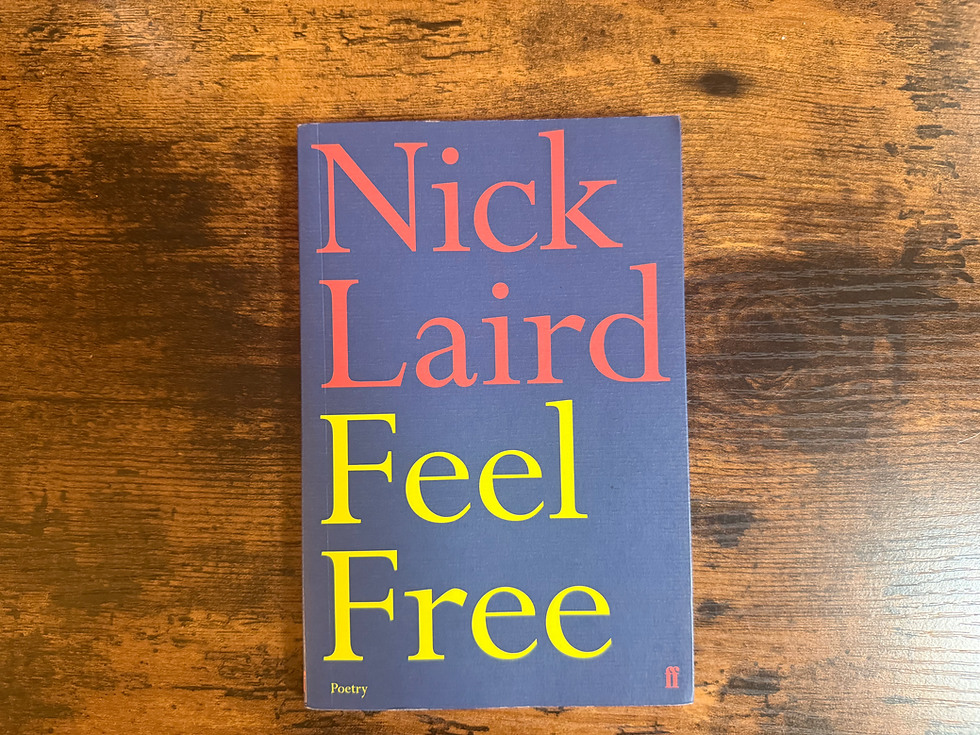
I felt good about my answer and was prepared to take on the class despite my minimal poetry experience. After the session ended, being the good (attention-seeking) student I was, I asked my professor if she had any poet recommendations for me. She told me to take a look at the Northern Irish poet, Nick Laird. She specifically told me to look at his poem “Feel Free,” which would pair well with our upcoming assignment: write a poem using anaphora, a figure of speech characterized by a repeated phrase at the beginning of each line (i.e., “I want…I want…I want…”).
Initially, this form seemed a little simplistic to me, something akin to an elementary school icebreaker: “I am a student…I am a son…I am a soccer player.” Having gone out of my way to ask for a recommendation, though, I now had to follow through; I went to Galignani Bookstore on Rue de Rivoli and got myself a copy of “Feel Free.”
It took me a few reads to understand the impressiveness of the titular poem. Laird uses anaphora in a way that feels conversational; the repetition of the phrase is clear: “...I like to interface / with earth…I like to hang / above the ground…I like the fact / were ‘supercooled star matter’…” But the thoughts are separated; each line is not a monotonous repetition of “I like…I like…I like…” but rather a seamless integration of various images, philosophical musings, and lighterhearted gestures.
The poem, a seemingly neat triptych, jumps from location to location, thought to thought; just as we begin to think we are localized, we are someplace else. The poem commences with the hook: “To deal with all of the sensational loss I like to interface / with earth.” The first section serves as a setup to this list poem form, staying fairly local as compared to the other two sections; the speaker has “...[Walked] off a Sunday through the high fields,” describing the simple joys of “...[Setting] aside a day a week, Shabbat, / to not act.”
The second section of the poem feels more desperate, single lines sharing multiple “I like” statements: “I like a steady disruption. I like it when the solid mantle turns / to shingle and water rushes up it over and over, in love.” The third section seems to abandon the anaphora form altogether, beginning with the quippy:
I can imagine that my first and fifth marriages will be
To the same human, a woman, the first marriage working
Well enough that we decide to try again as soon as it’s,
you know, mutually convenient…
Reading further in the collection, I found what is - to this day - my favorite poem of Laird’s: “Silk Cut.” In this moving poem, Laird succinctly captures the male experience of unexpressed vulnerability. The poem, which centers around the unspoken love in a father-son relationship, is a lot more compact than “Feel Free:” three stanzas of four lines each, boxy like a sonnet. Note: Because the poem is short, I feel it is important to include it in its entirety.
I was five and stood beside my dad
At a junction somewhere in Dublin
When I slipped my hand in his
And met the red end of a cigarette
But now our hearts are broken
We walk down to the Braeside
Where we can get a proper pint
And his voice tears up a bit
About the emptiness in the house
And we are going home, waiting
At the turn for the traffic, when I find
I have to stop my hand from taking his.
In contrast to “Feel Free,” “Silk Cut” uses description without inserting internal thoughts; its effectiveness comes from its images, from the action unfolding around the speaker of the poem. Laird uses coordinating conjunctions expertly, moving from concrete images to simple (almost removed) statements: “...And met the red end of a cigarette / but now our hearts are broken.” Additionally, Laird refrains from using end-stopped punctuation until the last line, creating an effect of the poem happening to the speaker (and happening quickly), rather than the speaker having any agency in the writing of the poem.
What I found in both “Feel Free” and “Silk Cut” was a contained messiness that my professor encouraged me to strive for in my own work. I had a tendency to end my poems neatly, but my professor suggested that I allow my work to go in more unexpected directions. Laird’s poetry clarified this for me, illuminating the Poem’s ability to release things messily, to create juxtapositions of subconscious images and thoughts that want to be expressed. Laird also showed me the power of simplicity in poetry. In the incredibly poignant final three lines of “Silk Cut,” he writes,
And we are going home, waiting
At the turn for the traffic, when I find
I have to stop my hand from taking his.
These lines are fairly straightforward; Laird doesn't have to use heightened language for the reader to understand the love he has for his father. In fact, the repression of love is clearer from the simple tonal register he uses.
One weekend that summer abroad, my girlfriend and I stayed at my childhood best friend, Noah’s, apartment in London; Noah and I picked up right where we left off, listening to The Backseat Lovers and drinking wine on his patio. On the first night of our stay, cozied up in linen sheets, I picked up “Feel Free,” and flipped to page twelve.
I treat the poem like an instruction manual. I “...interface / with Earth,” I “...press my back on a housing / of actual rock,” experience the “coldness which lives for a while on the skin.” But most of all, I relish the final instruction, my eyes glossing over:
…I like to lie
here
With my eyes closed and think about my schoolfriends’ houses
before
choosing one to walk through slowly, room by sunlit room.
The next day, we leave to take the Eurostar back to Paris; the ending isn’t neat, Noah and I hug goodbye in that removed male way. And as Noah moves to cross the platform, I have to stop my hand from taking his.


